New: Occupancy Insights.
Daily headcount, attendance trends, and RTO reports for your office.

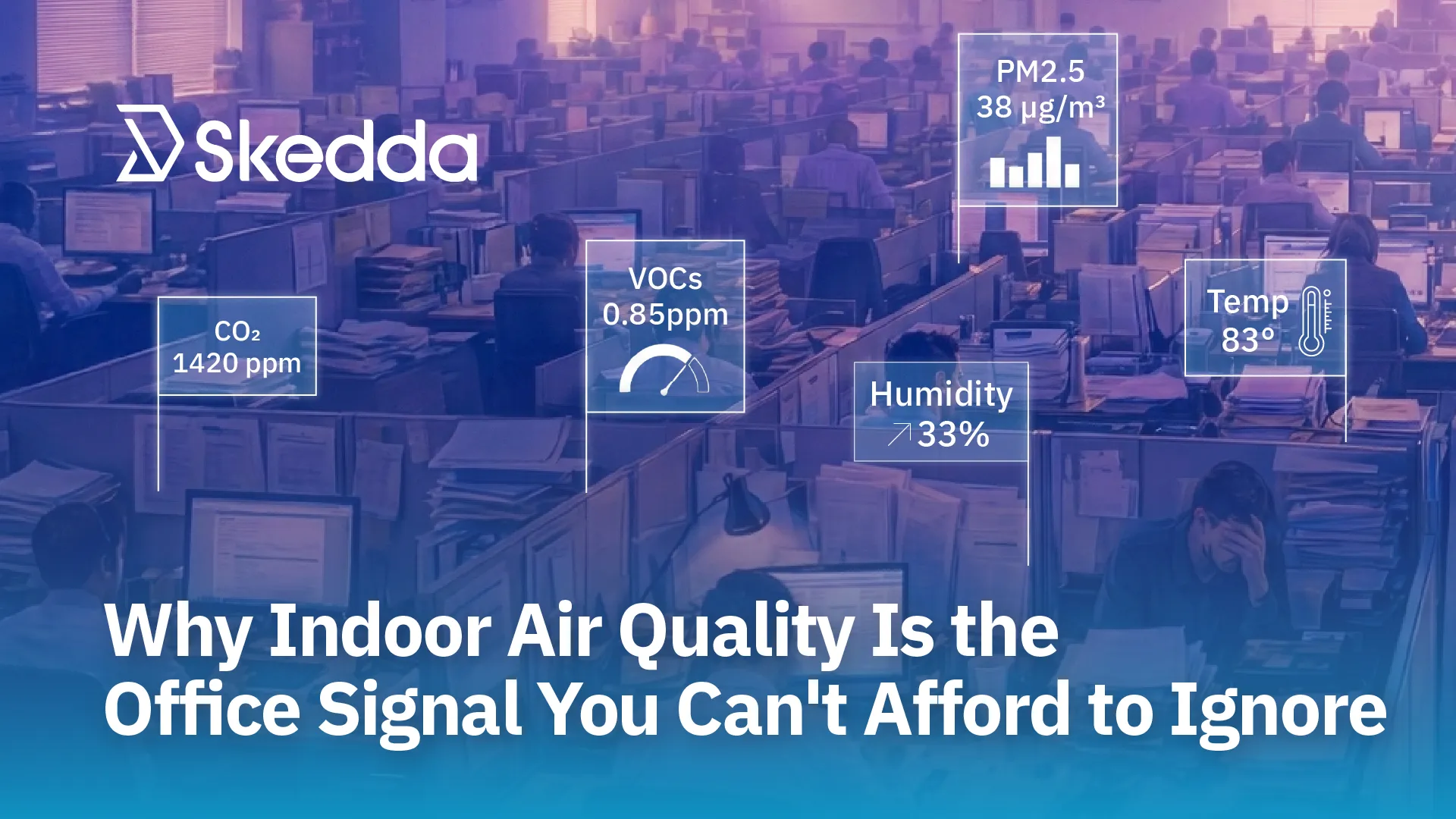
Picture a Tuesday afternoon. The third-floor conference room is on its fourth back-to-back meeting. By 2:30, the room is warm, the air feels thick, and everyone's blinking a little harder at their screens.
The CO₂ concentration has been climbing since the first meeting at 9 a.m. It's now past 1,200 ppm—a level that research links to measurable declines in strategic thinking and decision-making. The air isn't just uncomfortable; it's making the work worse.
Indoor air quality (IAQ) is one of the most consequential signals your team can monitor. It sits at the intersection of employee health, cognitive performance, compliance, and sustainability. And in a flexible office—where occupancy swings wildly between Monday and Wednesday, where buildings are aging, and where regulations are tightening—it's also one of the hardest signals to manage well.
This post explains what's changed, what to monitor, and why the air inside your office deserves the same strategic attention as utilization data and employee sentiment. If you're ready for the operational playbook—how to act on IAQ data, stay ahead of regulations, and build a proactive response plan—read Part 2: The Office Air Quality Action Plan: How to Monitor, Respond, and Stay Ahead.
If you ask facilities leaders what their top priorities are in 2026, occupant wellbeing will land near the top of the list. JLL's Global State of Facilities Management Report 2025 found that occupant wellbeing and workplace safety now ranks as the second-highest FM priority, tied with operational reliability and resilience. Gensler's 2025 Global Workplace Survey found that 40% of global workers prioritize access to natural light and operable windows—and that newer, recently remodeled offices score meaningfully higher on environmental factors like air quality and temperature control.
The data says we care about the air. The reality in most buildings says otherwise.
Despite the stated priority, most organizations still don't continuously monitor indoor air quality. Many rely on periodic assessments, scheduled HVAC maintenance, or—worst of all—waiting for complaints. The result is a gap between what FM leaders say matters and what they actually track in real time.
IAQ is uniquely exposed to compounding pressures. External factors like wildfire smoke, urban pollution, and seasonal pollen can push outdoor air quality into unhealthy ranges, and those pollutants infiltrate buildings even with windows sealed. Internal factors like occupancy surges, cleaning chemicals, fresh paint, and new furniture off-gas volatile compounds into shared spaces. And infrastructure limitations—aging HVAC systems, legacy ductwork, buildings designed for a different era of work—mean the systems responsible for delivering clean air often aren't up to the task.
Related reading: From Reactive to Rhythmic: How High-Performing Facilities Teams Run the Hybrid Office
Flexible work has stabilized, but office use is still highly uneven. CBRE's occupancy benchmarking data shows that average office attendance sits well below full capacity, with a global five-day average utilization of 39% but peak-day utilization reaching 64%. Kastle Systems' access-control data adds further detail: Tuesdays are typically the busiest day, Fridays the quietest, and midweek attendance is significantly higher than on Mondays or Fridays.
For teams still running ventilation on a fixed schedule, this swing creates a specific and measurable IAQ problem.
More people mean more CO₂ exhaled, more body heat, more humidity, and more particulate matter circulated through shared air. A conference room that breathes fine with four people at 10 a.m. on a Monday may be gasping with twelve people at 2 p.m. on a Wednesday. The HVAC system serving that zone was likely designed for consistent, moderate occupancy—not for a 2–3x swing between the quietest and busiest day of the week.
This is where occupancy-adjusted ventilation becomes critical. Rather than delivering the same volume of outdoor air regardless of how many people are in the building, demand-controlled ventilation (DCV) adjusts airflow based on real-time occupancy signals—typically using CO₂ sensors as a proxy for the number of people breathing in a zone. ASHRAE Standard 62.1-2022 explicitly supports this approach, with provisions that allow outdoor airflow to reset based on current population rather than maximum design occupancy.
The implication is straightforward: if your ventilation schedule doesn't flex with your attendance patterns, your busiest days are your worst air quality days. And that's not a coincidence—it's a rhythm problem that needs a systemic response.
Not all air quality metrics are created equal. Here are the five your team should be tracking and the thresholds that matter.
CO₂ is the single most useful proxy for ventilation adequacy. Outdoor ambient levels sit around 420 ppm. Indoors, levels above 1,000 ppm generally indicate that fresh air exchange is insufficient for the number of occupants. Above 1,200 ppm, the effects start showing up in the work itself.
The COGfx study, led by researchers at Harvard T.H. Chan School of Public Health and published in Environmental Health Perspectives in 2016, found that cognitive function scores were 15% lower at approximately 945 ppm CO₂ and 50% lower at approximately 1,400 ppm, compared to well-ventilated conditions at around 550 ppm. The steepest declines were in strategic thinking, information usage, and crisis response. A 2023 meta-analysis of 15 studies published in Indoor Air confirmed the pattern: complex cognitive task performance declined significantly at CO₂ concentrations between 1,000 and 1,500 ppm.
In practical terms, a packed conference room with poor ventilation isn't just uncomfortable—it's actively degrading the quality of the decisions being made inside it.
PM2.5 refers to airborne particles smaller than 2.5 micrometers—small enough to penetrate deep into the lungs and enter the bloodstream. In an office context, PM2.5 is especially relevant during wildfire seasons, in urban locations near construction sites or heavy traffic, and in buildings with poor air sealing. These particles infiltrate indoor spaces even when windows are closed.
The World Health Organization's 2021 Global Air Quality Guidelines recommend an annual mean concentration below 5 µg/m³ and a 24-hour mean below 15 µg/m³. For context, during major wildfire events, outdoor PM2.5 concentrations can spike well above 100 µg/m³. Without adequate filtration, a meaningful portion of that finds its way indoors.
VOCs are gases emitted by a wide range of indoor sources: new furniture, carpet, paint, adhesives, cleaning products, printers, and even dry-erase markers. Concentrations tend to spike after renovations, deep cleans, or when new furnishings are installed. Chronic low-level exposure is associated with headaches, fatigue, eye and respiratory irritation, and reduced concentration.
The COGfx study also measured the impact of VOCs on cognition, finding a 13% decrease in cognitive scores for every 500 µg/m³ increase in total VOC concentration, independent of CO₂ effects. This means a freshly painted office or a recently cleaned conference room could be affecting cognitive performance in ways that won't show up as a formal complaint but will show up in the quality of the work.
Humidity is the Goldilocks metric: both extremes cause problems. Below 30% relative humidity, mucous membranes dry out, skin becomes irritated, and airborne virus transmission increases. Dry air allows respiratory droplets to stay suspended longer. Above 60%, the environment becomes hospitable to mold, dust mites, and bacterial growth. The ideal range for most office environments is 40–60% relative humidity.
In flexible offices, humidity can be surprisingly volatile. High-occupancy days push humidity upward (people exhale moisture), while low-occupancy days with aggressive HVAC cycling can pull it too low, especially in winter when outdoor air is already dry.
Temperature isn't technically an air quality metric, but it's inseparable from how people perceive and experience the air. Thermal discomfort is consistently the most common category of facilities comfort complaints. ASHRAE Standard 55 recommends a general range of 68–72°F (20–22°C) for typical office work, though individual comfort varies.
Temperature matters for IAQ monitoring because it often co-occurs with other issues. A room that's too warm and stuffy usually has elevated CO₂ and humidity. Addressing temperature in isolation—without checking what else is happening with the air—means treating symptoms while the root cause persists.
The important thing to understand is that these five metrics don't operate in isolation. High occupancy drives CO₂ and humidity up simultaneously. Poor ventilation affects CO₂, VOCs, and temperature together. Monitoring any one metric alone gives you a partial picture. Monitoring all five gives you a diagnostic.
Utilization data is the missing link between your booking calendar and your air quality. Skedda's Workplace Intelligence shows you exactly which spaces are running hot on peak days so your facilities and HVAC teams can act on real attendance patterns, not assumptions. See how it works with a demo.
Many organizations that monitor indoor air quality track only CO₂ and temperature—the “check the box” metrics. That's a good start, but it leaves significant blind spots.
VOC spikes after hours are one of the most overlooked patterns. Cleaning crews using chemical-heavy products in the evening can leave residual VOC concentrations that haven't fully dissipated by the time employees arrive the next morning. PM2.5 infiltration on poor outdoor air quality days is another: unless you're monitoring particulate levels inside the building, you won't catch the days when outdoor pollution quietly degrades your indoor environment. Humidity creep in interior zones with poor airflow—bathrooms, server rooms, or windowless conference rooms—can create localized mold risks that whole-building sensors miss entirely.
But the signals that most sensor setups miss aren't all on the sensor side. Some of the most valuable IAQ signals are behavioral.
When certain rooms or zones are consistently underbooked, even when the rest of the office is at capacity, it often signals that something about the space is driving people away. It might be the temperature, the stuffiness, or an odor that no one has formally reported. If your booking data shows that Conference Room 4B has been avoided every Wednesday afternoon for three months, that's not a coincidence.
Rising comfort tickets that mention “stuffy air,” “headaches,” or “too warm” are another leading indicator. Employees often file these tickets individually—one here, one there—and your team never aggregates them into a pattern. But when you pull them together by zone and time of day, they can point directly to a ventilation problem.
And then there are the silent signals: employees bringing personal fans to their desks, people clustering in one wing of the floor, colleagues choosing to take calls from the lobby instead of the conference room. These behaviors are data. Sensors just don't capture them.
The strongest IAQ monitoring approach combines sensor data with behavioral data. One without the other leaves you either technically informed but operationally blind, or anecdotally aware but unable to diagnose the root cause.
For your team, the case for better IAQ monitoring is intuitive: cleaner air means fewer complaints and healthier occupants. But for leadership, the case needs to be quantified. Here's how to frame it.
That COGfx data from Harvard and Syracuse translates directly into business terms. If your busiest meeting rooms hit 1,200 ppm every peak day, and those rooms host the meetings where strategic decisions are made, you're making your worst decisions in your worst air. That's not a facilities problem. It's a performance problem with a facilities solution.
Beyond cognitive performance, poor IAQ drives measurable downstream costs. Sick building symptoms—headaches, fatigue, respiratory irritation, difficulty concentrating—increase absenteeism and presenteeism. Gensler's 2025 Global Workplace Survey found that employees in great workplaces are nearly three times more likely to stay with their company, and environmental factors like air quality are part of what distinguishes a great workspace from a mediocre one. If people associate the office with feeling worse—stuffy air, headaches, afternoon drowsiness—they'll vote with their feet.
The practical advice when making this case: don't ask leadership for a new IAQ dashboard. Connect IAQ improvements to metrics they already care about:
If you can show that fixing a ventilation issue reduced comfort complaints by 40% in that zone, you've made the case in language the CFO already understands.
Getting IAQ right in 2026 means treating it as a signal, not a checkbox—the same way you treat utilization data or employee sentiment.
JLL's 2025 Workforce Preference Barometer found an 84% correlation between positive workplace experiences and favorable attitudes toward office attendance. Occupant wellbeing isn't a soft metric; it ties directly to whether people want to be in the building.
This is the shift from reactive compliance (meeting a minimum ventilation standard) to proactive experience management (using environmental data to create a workplace that people actively choose). When IAQ data is combined with occupancy data, comfort ticket data, and employee sentiment data, it becomes one piece of a comprehensive picture of workplace health. And when your team can act on that data—adjusting ventilation, modifying booking policies, flagging infrastructure gaps—you're no longer just maintaining buildings. You're shaping the employee experience.
That's the strategic reframe. IAQ is not a checkbox. It's a signal. And the teams that read it well will run better offices.
Ready for the operational playbook? Read Part 2: The Office Air Quality Action Plan: How to Monitor, Respond, and Stay Ahead—covering regulatory requirements, the analyst's framework for turning sensor data into action, seasonal checklists, and where workspace management tools like Skedda fit in.
What indoor air quality metrics should facilities teams monitor in 2026?
The five most important IAQ metrics for office environments are CO₂ (a proxy for ventilation adequacy), PM2.5 (fine particulate matter, especially relevant during wildfire season), VOCs (volatile organic compounds from furnishings and cleaning products), humidity (ideal range 40–60%), and temperature (optimal range 68–72°F/20–22°C). Monitoring all five together gives a comprehensive picture of air quality rather than a partial one.
What CO₂ levels are safe for an office?
Outdoor ambient CO₂ levels are approximately 420 ppm. Indoor levels above 1,000 ppm indicate insufficient ventilation for the current occupancy. Research from the Harvard/Syracuse COGfx study found that cognitive function—particularly strategic thinking and decision-making—declines measurably at concentrations above 950 ppm, with a roughly 50% drop at 1,400 ppm. Most IAQ guidelines recommend keeping indoor CO₂ below 1,000 ppm in occupied spaces.
How does flexible work affect indoor air quality?
Flexible work creates uneven occupancy patterns, with attendance often 2–3 times higher on peak mid-week days than on Mondays or Fridays. This volatility puts disproportionate stress on HVAC systems during peak days, leading to elevated CO₂, higher humidity, and increased thermal discomfort in the spaces that are most heavily used. Static ventilation schedules can't accommodate these swings, which is why demand-controlled ventilation and occupancy-aware operations are critical.
Why is indoor air quality a productivity issue and not just a comfort issue?
Research consistently links elevated indoor CO₂ to measurable declines in cognitive performance. The Harvard/Syracuse COGfx study found a roughly 50% drop in cognitive function at 1,400 ppm—with the steepest declines in strategic thinking, information usage, and crisis response. In a knowledge-work environment, degraded air quality doesn't just make people uncomfortable—it makes the work worse. Framing IAQ improvements in terms of cognitive performance and retention gives you a stronger case for leadership investment.
What behavioral signals indicate an air quality problem in the office?
Behavioral signals that often precede or accompany IAQ issues include avoidance patterns (rooms or zones consistently underbooked), rising comfort tickets mentioning stuffiness or headaches, employees bringing personal fans to their desks, and people clustering in certain areas while avoiding others. These behavioral signals are most valuable when cross-referenced with sensor data to confirm whether a ventilation or air quality issue is the root cause.
Our team is ready and waiting to talk through your specific desk scheduling requirements and see how Skedda could work for you.

.svg)