NEW
Booking data, wherever you need it:

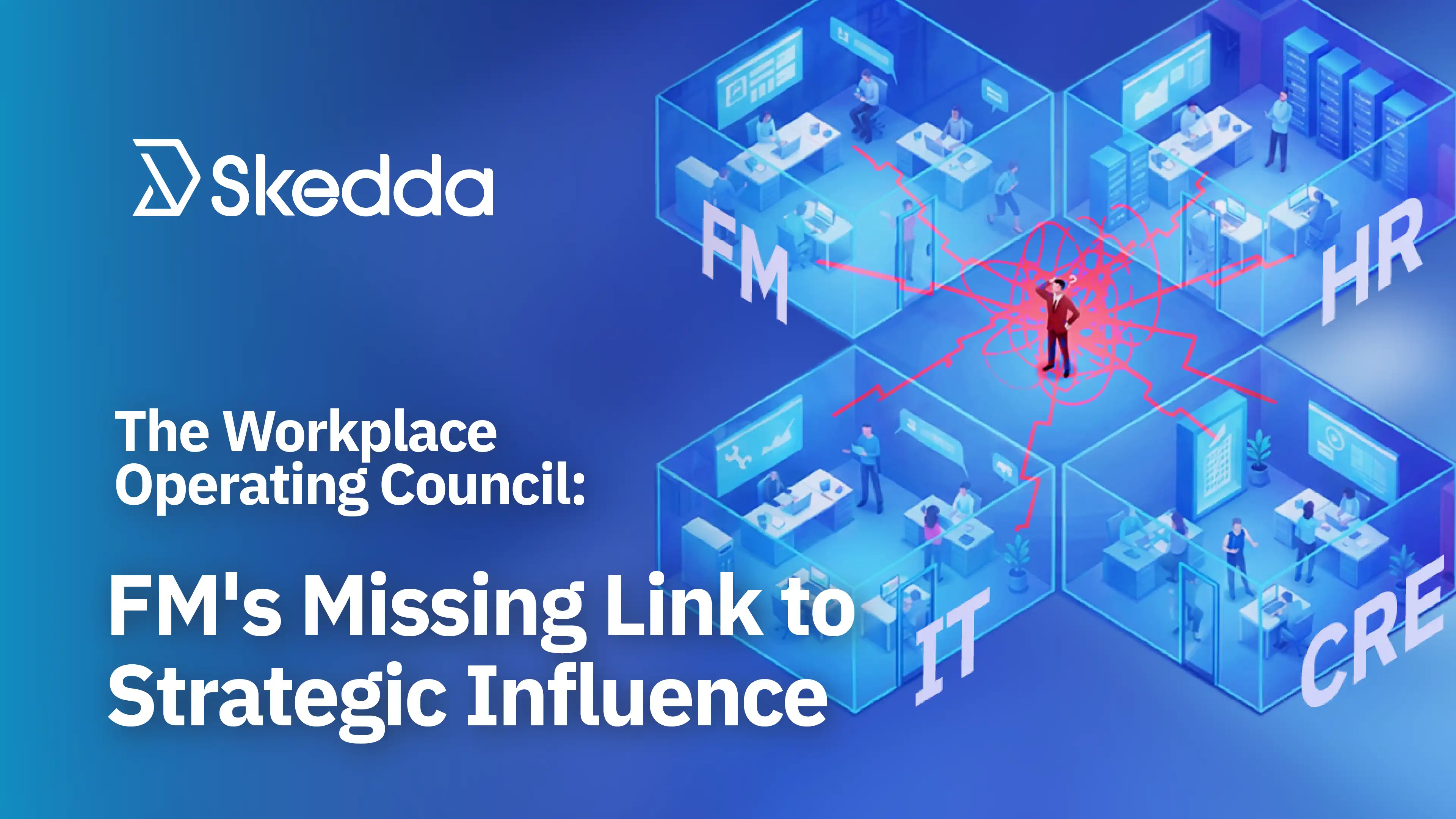
Here's a scene that plays out in organizations every week.
A new hire starts on Monday. HR processed the offer. IT has their equipment on the list. Facilities adjusts the floor plan. Everyone did their job, but no one owned the handoff between them. So the new employee shows up to find no desk assigned, no laptop provisioned, and no badge to get past the second-floor turnstile.
No one intended this. It happens anyway.
“Real estate and facilities are typically the second or third highest cost on an organization's books,” says Larry Charlip, Director of Real Estate and Occupancy Planning at Roku.
Yet the decisions that determine how that space performs get made across departmental lines, without a shared owner or a shared process. You can have the best utilization data, the most sophisticated occupancy tracking, and a seat in the leadership meeting—and still lose the employee experience in the gap between departments.
The new hire scenario isn't just an awkward onboarding story. It's a symptom of a structural problem that compounds across every place where departments have to hand work to each other. And it carries a real price tag.
Organizations lose an estimated 2+ hours per employee per day to coordination overhead when processes aren't standardized (Tallyfy). When organizations fix those processes, they see 42% faster task completion and a 48% reduction in manual errors.
So why does the problem persist? The answer isn't culture. It's architecture.
FM reports to the COO, measured on uptime, service delivery, and operational efficiency.
HR reports to the CEO, measured on headcount, retention, and employee satisfaction.
IT reports to the CTO, measured on system uptime, security posture, and ticket resolution.
CRE typically reports to the CFO, measured on cost per square foot and lease efficiency.
Each team is incentivized to optimize their own lane, which means no one is naturally incentivized to own the intersections between lanes. When everyone is accountable for their silo and no one is accountable for the handoff, the handoff fails every time.
The structural misalignment shows up in four recurring patterns. Each one is distinct, but they all share the same root cause: no documented, role-specific process for transferring ownership across teams.
This is the most common and most visible failure point: the new hire scenario scaled across every employee start date in your organization. Without an integrated process, results are chaotic: HR may forget to flag a new hire to facilities, IT may be unaware until the person physically shows up, and the new employee sits without workspace, system access, or equipment for days.
The frustrating part is that no single team failed. Everyone did their part, but the handoff had no owner. There was no cross-functional handoff checklist, a single document that defines who does what, in what sequence, and who confirms completion before the next step starts (more on this below).
Conference room technology sits in a persistent gray zone. The hardware (screens, cameras, cables, speakers) might technically be IT's domain. The physical room, the power supply, the furniture, the HVAC—that's FM's territory. But when a room goes dark before an all-hands, no one can quickly answer whether it's an A/V issue or a power issue.
While two teams figure out whose ticket it is, thirty people reschedule the meeting and the employee experience takes a quiet hit.
HR decides a team is moving from the third floor to the fourth. FM manages the physical setup—furniture configuration, signage, neighborhood designation. IT handles the cabling, switch ports, and device provisioning.
In theory: a smooth parallel operation.
In practice: FM finishes the physical setup before IT has completed the network drop. IT shows up after the team has already moved in and has to re-pull cable. The team spends their first week on the new floor dealing with connectivity issues and no one is sure who to call.
Without a shared handoff checklist, these moves become ad-hoc operations that succeed based on individual heroics rather than repeatable process.
This is perhaps the least-discussed but most expensive failure pattern. Real estate teams negotiate leases, plan new layouts, and make portfolio decisions, often without looping in FM on the operational implications.
The result: spaces that are architecturally beautiful and operationally difficult. Layouts that look efficient on a floor plan but require disproportionate maintenance. Amenities that sound compelling in a lease negotiation but drive up FM's service burden in ways that weren't budgeted.
When FM isn't consulted upstream in real estate decisions, the cost doesn't disappear. It just gets discovered later, buried in the operational budget and attributed to “higher-than-expected maintenance costs” rather than traced to its actual source: a planning process that didn't include the person who has to run the building.
Facilities management has never been more strategically positioned and never more dependent on other departments to actually deliver on that positioning.
Think of it this way. The best FM teams are the heart of the office—sensing what the workplace needs, adjusting to changing patterns, ensuring the environment stays healthy and productive. But a heart can't function if the arteries are blocked.
The cross-functional alignment problem isn't a relationship issue to be solved with better communication. It's a structural problem that requires a structural fix.
Leading organizations have recognized this and are building one: the workplace operating council.
A workplace operating council is a formal, cross-functional governance structure—typically including FM, HR, IT, and Finance—with shared KPIs, defined decision rights, a regular operating cadence, and joint accountability for integrated workplace outcomes like “experience per square foot” or “cost per productive seat.”
This is not a standing meeting where everyone shares updates or a weekly check-in that gets canceled when someone's calendar is full. It's a governance mechanism: a structure that gives each department a stake in shared outcomes and a clear process for making decisions that cross departmental lines.
Most organizations already have plenty of meetings between these departments. What they don't have is a structure that gives those meetings decision-making authority, shared metrics to discuss, and a documented process for resolving cross-functional conflicts. Without those three elements, everyone just goes back to their silo and optimizes for their own metrics.
A workplace operating council functions when it has four things:
If the workplace operating council is the governance structure, the cross-functional handoff checklist is the operational tool that makes it executable at the transaction level.
A handoff checklist is a documented, role-specific trigger list for every process that crosses departmental lines. For onboarding, it might look like this:
No step relies on someone remembering to send an email. No step waits for one department to happen to notice that another has finished. Each completion triggers the next action automatically, or at minimum, via a documented notification protocol.
The same logic applies to moves, room maintenance, lease negotiations, and any other process where FM, HR, IT, or CRE have to hand work to each other. Treating handoff checklists as strategic checkpoints rather than administrative overhead is one of the clearest behavioral differences between high-performing FM teams and reactive ones.
The end-goal is to make the coordination that currently depends on individual heroics become a repeatable, auditable process.
Cross-functional coordination has a data problem underneath it. When each department is reporting metrics pulled from different systems with different definitions, you get a situation where executives are making decisions based on different pictures of the same office.
The CFO thinks cost per seat is $X. The COO thinks peak utilization is Y%. The CEO thinks the team is back in the office five days a week. None of them are wrong, and yet none of them are right.
The root cause is definitional. What counts as “utilization?” Is it bookings? Check-ins? Sensor-confirmed presence? Does “occupancy” include the lobby? The parking garage? The cafeteria? What does “headcount” mean—badge holders, active employees, contractors? Each department has answered these questions for its own purposes, and those answers don't always match.
When different systems produce different numbers for the same KPI, you get a culture of distrust in analytics—and executives who can't trust the data stop acting on it. That's the worst outcome: an organization that has invested in data collection but can't use the data to make decisions, because no one can agree on what the data means.
Download the Data Inventory Spreadsheet to see all your data sources and their owners all in one place.
The fix starts with a Workplace Data Dictionary: a shared document, maintained jointly by FM, IT, HR, and Finance, that defines every metric used in cross-functional reporting. Not just what it means, but how it's measured, from which system, at what frequency, and who owns keeping the definition current.
This is not a one-time exercise. Definitions drift as systems change, policies evolve, and new tools get added. The workplace operating council's monthly cadence should include a standing review of any definition changes that affected cross-functional reporting in the past month. This can be a short, disciplined process that prevents the data dictionary from becoming stale.
When this shared language is established, something shifts. Meetings get shorter and decisions get faster. Leadership stops arguing about whose numbers are right and starts discussing what to do. JLL's research reinforces this divide: companies with clean data and modern integrated systems are advancing their workplace intelligence capabilities, while those relying on fragmented systems and inconsistent definitions are falling further behind because they lack the data foundation to build on.
The workplace operating council is a governance structure. The handoff checklist is a process tool. Both require a data infrastructure that can actually deliver the shared visibility each department needs to coordinate effectively.
That's where Skedda is built to help—not as a replacement for cross-functional governance, but as the connective tissue that makes it operational.
Removing the friction from cross-departmental data flows. Skedda's two-way calendar sync with Microsoft 365 and Google Workspace means that booking data flows automatically into the calendaring systems your HR and IT teams already live in.
SCIM provisioning ensures that when IT adds or removes a user in Entra ID or Okta, their workspace access in Skedda updates automatically—no manual handoff, no provisioning gap, no badge access without a desk.
Slack and Microsoft Teams integrations surface who's in the office in real time, giving FM, HR, and IT a shared occupancy signal without anyone having to query a separate system.
These integrations don't just reduce manual work. They eliminate the coordination moments that are most likely to fail (i.e., the ones that rely on someone remembering to send a message).
Giving FM the utilization data to show up credibly in a workplace operating council. One of the quiet barriers to effective cross-functional governance is that FM often walks into joint meetings with operational anecdotes while Finance brings spreadsheets and HR brings engagement scores. The power imbalance is real, and it shapes which department's priorities drive the agenda.
Skedda's Space Insights Dashboard changes that dynamic. It gives FM teams real-time utilization data, peak-day attendance patterns, space-type performance, and ghost booking rates—the kind of evidence that translates directly into the shared metrics a workplace operating council needs to make joint decisions. When FM can say “our fourth-floor collaboration neighborhood ran at 94% peak utilization on Tuesdays last quarter while the third floor ran at 31%—here's what I recommend we do about that,” they're not just reporting. They're leading.
Download the 2025 Modern FM Toolkit to translate your workspace data into stories that drive ROI.
Making the handoff checklist auditable. The cross-functional handoff checklist only works if people can verify that each step actually happened. Skedda's Auto Check-In and Wifi-based Occupancy Tracking close the gap between what was planned and what actually occurred, confirming presence without requiring manual check-in, detecting ghost bookings, and generating the “planned vs. actual” data that makes occupancy reporting credible.
When you can show that a desk was booked but never occupied, that a room was marked available but hasn't been checked in to in three weeks, that an office neighborhood is consistently booked out by 9am despite being listed as underutilized—you have the data to audit your own processes, surface handoff failures before they become patterns, and demonstrate that your utilization numbers are grounded in verified presence, not just reservation logs.
That's the foundation a shared data governance model needs. And it's the kind of evidence that earns FM a more credible voice in the cross-functional conversations that shape workplace strategy.
Check out more resources in this series on your journey to becoming an FM Analyst:
Our team is ready and waiting to talk through your specific desk scheduling requirements and see how Skedda could work for you.

.svg)