New: Occupancy Insights.
Daily headcount, attendance trends, and RTO reports for your office.

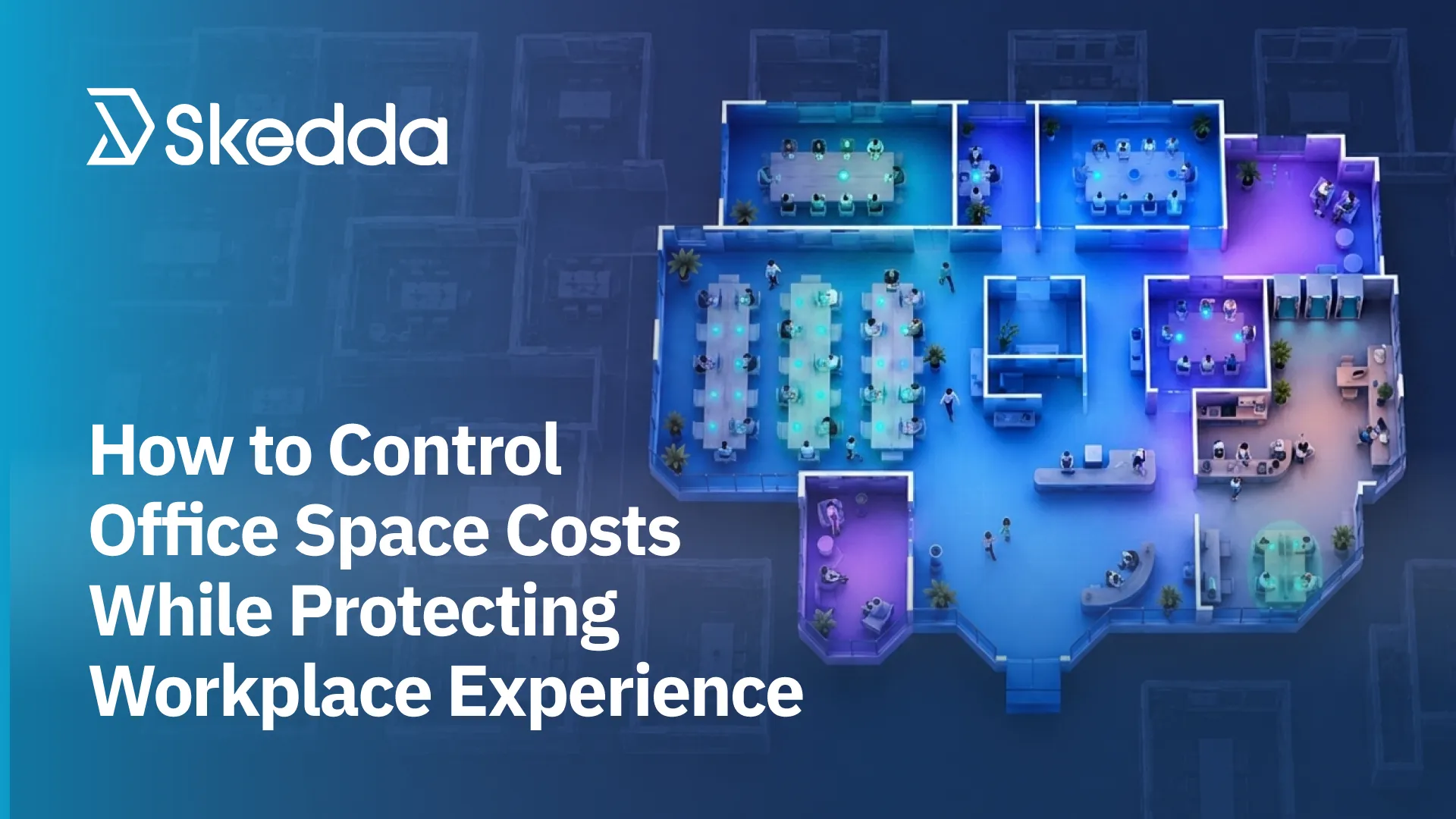
How do you control real estate costs while enhancing the workplace experience? That’s the question many facilities management leaders are being asked today.
The squeeze shows up in the industry's own priority list. In JLL's Global State of Facilities Management Report 2025, occupant wellbeing and workplace safety tie for the second-highest FM priority of the year, directly behind the cost efficiency that 81% of leaders rank at the top. The two objectives pulling facilities teams in opposite directions are the top two lines of the same list.
This is a playbook for FM leaders who’ve been handed both objectives at once. It’s a strategic framework for using space utilization data to defend a sharper, better-performing footprint, and a way to talk about it that the C-suite will actually act on.
Real estate and facilities are typically the second-largest cost on an organization’s books after labor. According to JLL’s Global State of Facilities Management Report 2025, 84% of corporate real estate and FM leaders cite budget constraints and rising operating costs as their top area of concern.
The supply side reflects the same gravity. In 2023, Cushman & Wakefield projected that 1.4 billion square feet of U.S. office stock would be functionally obsolete by 2030. CNBC projected that 2025 would be the first year in at least 25 years in which office removals would outpace new supply.
At the same time, employee expectations are rising, not falling. JLL’s Workforce Preference Barometer 2025 found that 84% of employees who are satisfied with their workplace view office attendance policies positively, while only 48% of dissatisfied employees feel negatively toward those mandates. Gensler’s 2025 Global Workplace Survey makes the link tangible: 90% of employees who like their workspace report being proud to work for their company, compared with just 47% of those disconnected from it.
The leaders who win this moment aren’t choosing between cost and experience. They’ve recognized that bad space strategy is the source of both problems. Underused floors drain budget while overcrowded peak days drain goodwill. By fixing the strategy, you fix both.
That’s what makes space utilization a strategy problem in 2026, not a real estate problem. The real question is whether your portfolio is actually shaped to match how your people work, across days, modes, and demand cycles.
Most utilization conversations focus on one cost: the cost of empty space. A floor at 30% utilization is paying full rent for a third of the activity. That’s an easier story to tell.
The harder story is the cost of overcrowded space. It’s the one most facilities leaders don’t bring to the C-suite, and it’s just as real.
CBRE’s 2026 Global Workplace & Occupancy Insights shows that global average office utilization has climbed to 53%, while average peak-day utilization now hits 80%. That figure exceeds the long-standing 65% planning target for the first time in the post-pandemic era. Kastle’s Back to Work Barometer confirms the weekly rhythm: attendance concentrates on Tuesday, Wednesday, and Thursday, with Tuesday typically the busiest day and Friday attendance falling well below the midweek peak.
That fluctuation is where the hidden costs live.
The hidden cost of underused space:
The hidden cost of overcrowded space:
The two costs are linked; the same office that’s empty on Monday is overwhelmed on Wednesday. A strategy built around the weekly average doesn’t work for either scenario. That means a peak-day strategy needs to exist alongside a slow-day strategy in flexible work environments.
Before getting into the strategic frame, it’s worth naming the operational levers that often sit alongside a space strategy. None of these replaces the strategic work. Ignoring them is how cost programs underdeliver.
Lease renegotiation and blend-and-extend. Lease renewals are the biggest single moment in any cost program. A defensible utilization baseline (covered in the playbook below) is what converts a renewal conversation from “we’d like a lower rate” into “here’s why we’re taking 30% less square footage.”
Sublease or partial sublease of low-utilization floors. A floor running at 25% utilization for eight consecutive weeks is a sublease candidate. The financial math is straightforward; the operational math (which neighborhoods can absorb the displaced headcount, with what mix changes) is the harder part.
Flex-space overflow for peak days. Coworking or on-demand workspace can absorb peak-day overflow without paying for the capacity 365 days a year. The dollar lever is usually small in absolute terms, but it solves some of your “need more space” issues when your office is closer to being right-sized.
Energy and service costs tied to actual occupancy. HVAC, lighting, and cleaning contracts sized for a steady-state building waste a meaningful share of operating cost on quiet days. In a peer-reviewed field study of commercial buildings, re-timing HVAC stop schedules to actual occupancy delivered roughly 14% in HVAC energy savings, without touching the lease. Cleaning and service contracts sized to real demand add savings on top, though those vary by contract.
A cost-per-occupied-seat baseline. Most FM teams report cost per square foot. CFOs respond to cost per occupied seat: total occupancy cost divided by the number of seats actually used on a peak day. A building with low utilization has a high cost per occupied seat even if the cost per square foot looks fine. That’s the number to put in front of the CFO.
These levers do the operational work. The strategic frame below is what makes them defensible.
The strategic frame that holds up under executive scrutiny isn’t a list of tactics. It’s a three-lever structure used together:
Match the total footprint to the demand the data actually shows. This is the lever the CFO understands instinctively: fewer floors, smaller floors, denser floors, or sublet floors. Right-sizing without the other two levers, though, is where most consolidation projects go wrong. You can shrink the building and still have an unusable office.
Change the composition of the space, not just the size. A 50,000-square-foot floor with 400 assigned desks and four meeting rooms is a very different asset than a 50,000-square-foot floor with 200 hot desks, 30 focus rooms, 12 collaboration zones, and a quiet library. Re-mixing is how cost reduction becomes experience improvement, because a portion of the savings funds the work modes the data shows people actually want.
Run the space differently on Tuesdays than on Fridays. Pre-condition HVAC for Wednesday peaks. Flex cleaning weight toward Tuesday-through-Thursday. Open or close floors based on booking signals. Stagger team attendance to flatten the peak. Re-timing supports more headcount in less space without degrading the experience.
No single lever works alone. Right-size without re-mix, and you’ll consolidate into a smaller version of the wrong office. Re-mix without right-size, and you’ll spend capital reconfiguring space you should be eliminating. Re-time without the other two, and you’ll smooth a peak in a portfolio that’s still fundamentally misshaped.
The teams making the most progress in 2026 are working all three in sequence: re-time first (because it surfaces real demand patterns), then re-mix (because it tells you what to keep), then right-size (because by then, you know exactly what you no longer need).
This is the playbook executives can follow and FM leaders can defend.
Before you can change the space, every department needs to agree on what counts as “utilized.” This is the step most teams skip, and it’s the one that undermines every downstream decision.
What counts as utilization? Bookings? Check-ins? Sensor-confirmed presence? WiFi sessions? Each method tells a different story, and if Finance, FM, IT, and HR are looking at three different numbers, there’s no one clear narrative to develop a coherent strategy.
A good first step is to triangulate booking data, check-in confirmation, and presence detection across at least 60–90 days. That’s enough time to see weekly rhythms, monthly variance, and the difference between a busy week and a busy quarter. Skedda’s Workplace Intelligence pillar shows the clean, consistent utilization data on which every other step in this framework depends. The Spaces Insights Dashboard and Precision Filtering let admins slice utilization by team, building, and space type, so the baseline conversation stops being a debate about whose data is right.
A successful space strategy cannot be based purely on utilization averages, since a 60% average that swings between 20% on Mondays and 95% on Wednesdays tells a completely different operational story than a steady 60% across the week.
Map demand in three dimensions:
This is where leading indicators start to matter. Comfort tickets and indoor air quality readings often surface space problems two to three weeks before booking data confirms them. A demand map that incorporates experience signals won’t surprise you.
This step separates strategic FM leaders from operational ones. Anyone can look at a utilization heatmap and point at the cold spots. The harder question is what’s preventing people from consolidating into the warm spots.
The constraints are almost always specific:
Naming the constraints is what turns a vague “we need to consolidate” into a specific, sequenced plan. It opens up the reinvestment conversation in Step 4. Skedda’s Custom Rules and Roles, capacity caps, Booking Approvals, and check-in rules are often the cheapest way to relieve a constraint that looks like a space problem but is actually a policy problem.
Hybrid offices don’t fail on average days; they fail on peak days. Design for the peak day, but be specific about how. That means:
Skedda’s Assigned Spaces lets admins decide if a space is bookable or assigned, which makes the right-size/re-mix conversation reversible: teams can pilot a neighborhood shift without committing to a buildout. The goal is work-mode fit on the day it matters, with a portfolio that’s still sized for the rest of the week.
The final step determines whether any of this gets approved. Translate the plan into the language each executive uses, and tie every recommendation to a decision they can make in the next 30–60 days.
A strong business case names what’s being cut, where the savings are being reinvested, and what success looks like at the 90-day, six-month, and one-year marks.
See your real utilization signal in one view. Book a 20-minute walkthrough of Skedda Workplace Intelligence. See how peer FM teams baseline utilization, identify peak-day constraints, and defend their space strategy to leadership.
Cost savings and experience improvements aren’t separate workstreams. When done well, they compound in both directions. Every dollar saved through consolidation funds a workplace improvement that increases the likelihood that people actually want to come in. Higher attendance justifies the remaining footprint. Better-utilized space generates more reliable data. More reliable data sharpens the next round of decisions. The positive cycle continues.
Done poorly, the same cycle runs in reverse. A consolidation that ignores work-mode fit creates scarcity. Scarcity creates frustration. Frustration drives avoidance. Avoidance reduces attendance, which weakens the case for the remaining real estate, which leads to another round of cuts.
The compounding points are predictable:
The Cushman & Wakefield Experience Per Square Foot™ framework names this trade-off directly. Cost per square foot tells you what you’re spending, while experience per square foot tells you what you’re getting. Both are the right units of measurement for the strategic conversation.
The fastest way to lose credibility in a space strategy conversation is to bring data that doesn’t hold up. These are the five most common mistakes that undermine otherwise sound utilization analysis.
1. Reporting averages without variance. A 60% average utilization is a meaningless number on its own. The story is in the variance: peak versus trough, by day, by floor, by team. Without variance, the peak-day capacity argument (which is where your workplace experience breaks down) disappears.
2. Conflating bookings with use. A room booked is not a room used. Ghost reservations routinely inflate utilization by 30–40% in offices without a check-in requirement. If your data doesn’t distinguish reserved from occupied, you have an incorrect scarcity story.
3. Treating utilization as a single number instead of a composite. Utilization without context (who’s using the space, for what work mode, with what outcome) is operational noise. The decision-ready version pairs utilization with experience signals (comfort tickets, sentiment) and cost-to-serve (energy, maintenance, total occupancy cost). One signal triangulated against two others is what produces an insight that executives can act on.
4. Mismatched definitions across departments. When Finance, IT, HR, and FM each define “utilization” differently, every cross-functional meeting becomes an argument over whose number is right rather than what to do. The fix is a shared workplace data dictionary, agreed upon before the next reporting cycle, not after the next disagreement.
5. Building the case once and never revisiting it. Hybrid demand that patterns shift. New teams form, policies change, and leases come up for renewal. A utilization baseline established in Q1 and presented unchanged in Q4 is a red flag. The leaders who win the long game build a quarterly reset into their operating rhythm and treat the space strategy as a living document.
The work doesn’t end with the analysis. It’s done when leadership has made a decision they can defend to their board.
That requires a different kind of artifact than the dashboard FM teams live in every day. Executives don’t want your raw data. They want your recommendation, your reasoning, and the decision they’re being asked to make.
The most effective format is the Clarity Stack: every space strategy proposal forced through four lines.
A worked example:
Three habits separate the FM leaders who get heard from the ones who get politely overridden.
The space strategy that gets approved is the one that arrives in the language of the people approving it. Start using data to tell the right executive narrative: Download The 2026 Modern FM Toolkit.
A well-tuned 2026 space strategy is a sharper one. Here's what it looks like in practice:
The footprint is matched to demand patterns that the data actually shows, not the demand patterns the lease was signed for. The mix of work modes (focus, collaboration, social, meetings) reflects how people actually work, with reinvestment flowing toward the modes that data and sentiment together identify as underserved. Operations flex across the week: HVAC preconditioned for peak days, cleaning weighted toward midweek, services scaled to projected headcount rather than theoretical capacity.
The booking system isn’t a scheduling tool. It’s the operational layer that makes the strategy executable. Governance prevents the ghost reservations that distort demand. Adoption ensures the data actually reflects reality. Workplace Intelligence surfaces the patterns that drive the next round of decisions.
Leadership doesn’t argue about whose utilization number is right. They have a shared definition, a shared dashboard, and a quarterly cadence that resets the plan based on what’s actually changed. The CFO trusts the cost story. The CHRO trusts the experience story. The CEO sees both as one strategy.
The office is the right size for the way people work now, mixed for the kinds of work they actually do, and run on a weekly rhythm that matches real demand. That’s the strategy, and it’s what cost control and a great workplace look like when they work in tandem.
Ready to bring a defensible space strategy to your next leadership review? See Skedda Workplace in action. It’s the platform 8,000+ organizations and 3 million users rely on to govern shared spaces, drive adoption, and turn utilization data into the insight that shapes the portfolio.
How much can I realistically save by reducing office space?
Savings vary by lease, market, and starting utilization, but the most defensible CFO-grade target is cost per occupied seat: total occupancy cost divided by the number of seats actually used on a peak day. Most organizations starting from a sub-50% utilization baseline can target a 20–35% reduction in total occupancy cost through a combination of consolidation, sublease, and demand-driven operations. The strongest programs reinvest a portion of those savings into the work-mode mix, so the experience improves alongside cost reductions.
How do I calculate the right office size for a hybrid workforce?
Start with peak-day demand, not average. A weekly average will size you for a day that doesn’t exist. Pull 60-90 days of booking data, identify the busiest day of the week, and size for that demand plus a 10-15% buffer for variance. Then break the headcount down by work mode (focus, collaboration, meetings, social), so the size question becomes a mix question. Skedda’s Workplace Intelligence helps surface peak-day demand patterns by team and space type.
What is a good office utilization rate in 2026?
The historical industry planning target was a 65% peak utilization rate. CBRE’s 2026 benchmarking shows global averages have now climbed to 53%, with peak-day utilization hitting 80%. The 65% target is no longer a stretch goal. The more useful question is the gap between average and peak: a portfolio with a 50% average and 85% peak needs a different strategy than a portfolio with a steady 60% across the week.
How do I stop ghost reservations from inflating my utilization data?
The fix is a check-in requirement with auto-release. When users have to confirm attendance, either actively (via an app or device) or passively (via WiFi or location signal), and unconfirmed bookings release back into inventory within 10-15 minutes, ghost reservations effectively disappear. Skedda’s Custom Rules and Roles, Auto Check-in, and Check-in Push Notifications are designed for exactly this. Most teams see a 15-30% improvement in usable peak-day capacity within the first month.
Is it better to sublease, consolidate, or renegotiate the lease?
It depends on lease timing and the shape of your underutilization. If a floor has been below 30% utilization for at least 8 consecutive weeks and the lease has 24+ months remaining, sublease is usually the right move. If the underutilization is distributed across multiple floors, consolidation is the right move. If a renewal is inside 18 months, renegotiation with a defensible utilization baseline is the strongest play. The decision is rarely either/or. Most strong programs combine all three.
How do I right-size for peak days without overbuilding?
Design for the peak day, but use office neighborhoods, governance rules that recycle no-show bookings, and a strong mix of work modes to flex capacity. Assigned desks should only be reserved for cases where the business need is unambiguous. Peak-day capacity recovery from governance alone (check-in enforcement, booking caps, approval workflows for high-demand spaces) is often greater than peak-day capacity created by adding square footage.
What’s the difference between space utilization and space occupancy?
Space occupancy refers to the number of people in the space at a given time—a simple headcount of physical presence. Occupancy can be expressed as a percentage (e.g., a 25-person conference room with 15 people inside = 60% occupancy) or as a raw number (e.g., “15 people in this meeting room”). Space utilization measures how often and how intensively spaces are actually used. It is usually tracked in percentages. Both are vital for smarter office planning.
Our team is ready and waiting to talk through your specific desk scheduling requirements and see how Skedda could work for you.

.svg)