NEW
Booking data, wherever you need it:

If you’re reading this, the per-user math on Robin has probably started to hurt. A workforce of 800 people, 120 actual bookable desks, and a bill that scales with every headcount line item, not with the rooms and desks anyone actually books. That gap is the most common reason teams start looking at Robin alternatives in 2026, and it shows up in the G2 reviews verbatim: “Robin isn’t used as much as it used to be so sometimes not worth the price” (Pat D., Sr. Director Finance, Capterra, March 2025).
This guide compares 10 desk booking software platforms that customers shortlist when they leave Robin, with current pricing, current G2 and Capterra ratings, the specific use case each one fits, and a migration section for teams worried about the disruption of moving off Robin mid-year.
We publish this guide. We’re including Skedda as a featured option at the top, with full disclosure of our biases and the things we don’t do well. The 10 numbered alternatives that follow are ordered alphabetically. Re-weight any of these criteria against your own priorities.
Per-user pricing models are the most common reason Robin customers run this comparison, so the table above leads with the pricing column. The five alternatives that use per-space, per-resource, or per-workspace pricing (Skedda, Archie, Envoy, Microsoft Places, Tactic) tend to be the strongest fits for cost-driven users who switch from Robin. The five per-user alternatives (deskbird, Eptura Engage, Gable, Kadence, OfficeSpace) win on other dimensions like UX, AI, or feature breadth.
For some teams, yes. We’re not going to pretend otherwise.
Robin is the strongest option in this guide for AI-driven scheduling. Their workplace dashboard pulls together attendance, visits, deliveries, and service requests into a single admin view that no other tool in this list matches. Their AI Scheduling Agent handles meeting conflicts, reschedules, and predictive desk booking based on user history. If you’re a 2,000-plus employee organization with a dedicated workplace operations team, those features earn their cost. Hootsuite, Politico, and TripAdvisor are Robin customers for a reason.
Robin also has a real edge on access control integrations. Their badge-swipe data ties cleanly into desk check-in, and the analytics pipeline that sits behind it is genuinely deep. For regulated industries running RTO mandates with badge-verification requirements, the data quality is hard to beat.
So if you’re at enterprise scale, you have an in-house workplace team to manage the platform, and AI scheduling is a top-three procurement priority, Robin is still a reasonable choice. The rest of this guide is for the teams who don’t fit that profile.
Four complaint themes show up repeatedly across G2, Capterra, and third-party review aggregators. We’ve quoted reviewers verbatim where possible.
Robin charges based on total employee count, not on the people who actually book a desk or room. For organizations with hybrid attendance patterns where half the staff comes in twice a month, the math gets ugly fast. ITQlick’s 2026 Robin pricing analysis puts the all-in TCO for a 100-user organization at roughly $35,000 per year, including licensing, implementation, training, and support. The same analysis pegs Skedda’s TCO at the same scale at roughly $15,000.
The G2 reviews are blunt: “Robin is an overpriced and poorly serviced platform that offers less than its many competitors at way too high a price.”
The pricing problem compounds when attendance softens. Pat D., a Sr. Director of Finance on Capterra (March 2025), put it directly: “Robin isn’t used as much as it used to be so sometimes not worth the price.” Abhishek S., a Software Developer (Capterra, February 2025), echoed it: “It's a little costly and can improve a bit for users."
This is the cost trigger that pushes most CFO-led reviews into switching. When attendance drops 30% from the pandemic-era peak but the seat license bill doesn’t, finance starts asking questions.
Robin’s sticker price is not the real price. As of April 2026, several core capabilities sit behind paid add-ons:
A Facility Manager on Capterra summarized it: “product falls short due to price point.”
Two specific complaints come up repeatedly:
Fred P. on Capterra: “In the event our facility underwent a renovation, you have to redo all the work you did in the first place.”
Historically, floor plan editing created bottlenecks because changes typically routed through Robin’s team rather than being self-service. For organizations that reorganize space more than once a year (which describes most hybrid offices in 2026), this becomes a recurring tax on time and budget.
As of May 2026, Robin has started offering a self-serve map design where organizations can generate maps directly from CAD files and make changes directly in the new map editor.
You don’t have to leave Robin. But these are the specific signals that push most teams to start the comparison.
If two or more of these apply, the rest of this guide is worth your time.
Disclosure: Skedda publishes this guide. Rather than rank ourselves alongside the alternatives, we’ve positioned Skedda as a featured option with full disclosure of our biases and limitations. The 10 numbered alternatives that follow are organized alphabetically. Re-weight criteria against your own priorities.
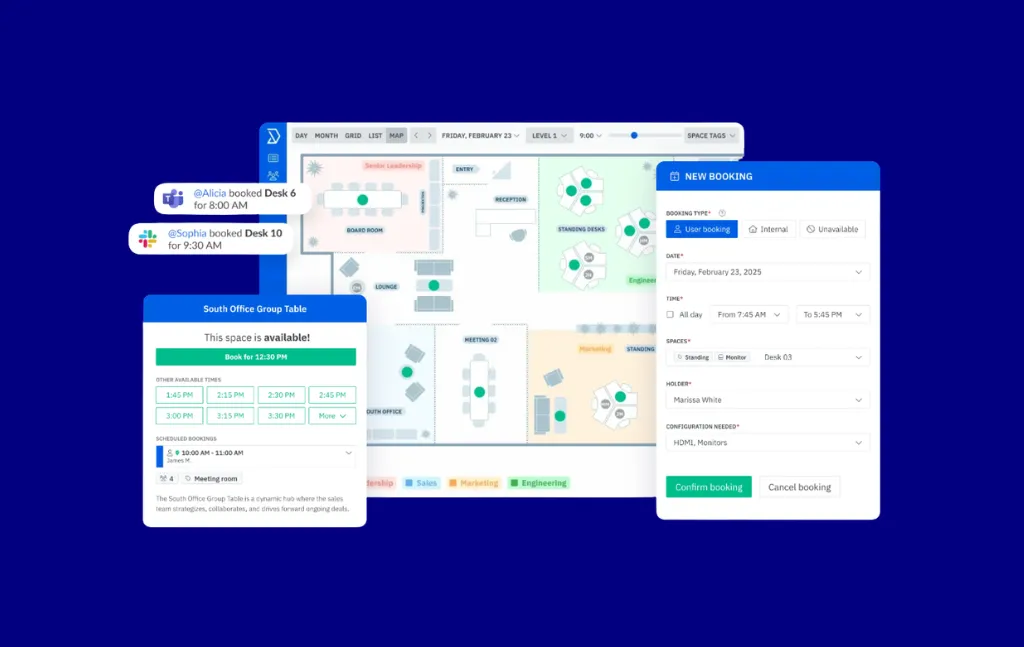
Skedda is a workplace space management platform that charges per bookable space instead of per user.
Best for Robin users who: want predictable per-space pricing and deeper booking governance as headcount grows, with costs that don’t scale with employee count.
How it compares to Robin: Skedda replaces Robin’s per-user pricing with per-space pricing, includes unlimited users on every plan, and includes floor plan edits, the rules engine, and core analytics in the base subscription rather than gating them behind add-ons.
Where it wins vs Robin: Predictable pricing as headcount scales, deeper booking rules engine (quotas, buffer times, conditions, approvals), interactive office floor plan edits at no cost, and inclusive standard support.
Where it falls short of Robin: Robin’s AI Scheduling Agent and predictive booking features are more advanced. If AI-assisted scheduling is in your top three procurement priorities, Robin’s roadmap is ahead of ours as of April 2026.
Core features:
Integrations: Microsoft 365, Microsoft Teams, Google Workspace, Slack, Okta, OneLogin, Azure AD, SCIM, SAML.
Pricing: Per space, published rates starting at $249/mo (Plus Plan, 35 spaces included), $349/mo (Premier Plan, 45 spaces included), Enterprise (custom quote). Visitor management add-on $99/mo. No per-user fees at any tier.
G2 rating: 4.8/5 (281 reviews). Included in G2’s Top 25 Office Products for 2026. G2 Leader 2023 to 2026. Best Support and Easiest Setup 2026. Capterra: 4.8/5 (226 reviews).
Honest cons: Visitor management is a paid add-on at $99/month. Zapier integration is outbound-only. No AI-assisted natural-language booking as of April 2026. Multi-language UI is primarily English. No native HRIS aggregator (provisioning via SCIM/SAML). Space booking rules are extensive, but if you need a full IWMS (maintenance ticketing, lease management, asset depreciation), Skedda is not that.
Bottom line for Robin switchers: Best fit for organizations with 100 to 2,000 employees, hybrid attendance under 70%, a larger office headcount than spaces available, and a workplace or IT lead who values predictable pricing and deep booking governance over AI scheduling. Not the right fit for enterprises with 5,000-plus employees who need a full IWMS, or for teams whose top procurement priority is AI-assisted scheduling. For a deeper head-to-head, see our Skedda vs Robin comparison.
Book a demo to see how the per-space math works for your headcount.
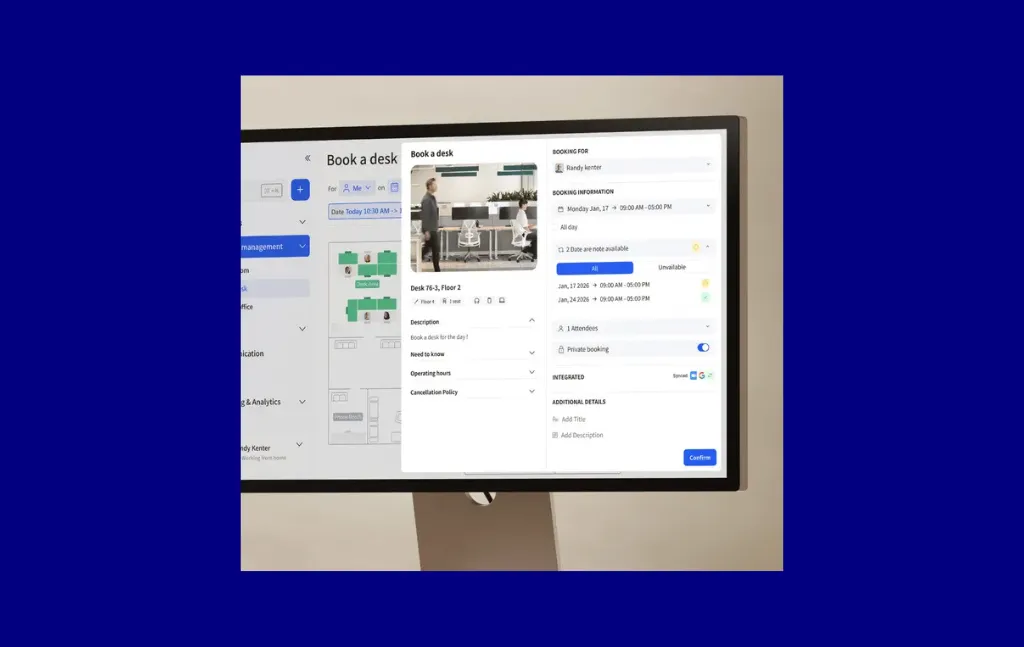
Archie is a workplace and coworking management platform with a strong SMB and coworking-operator base.
Best for Robin users who: run a hybrid office under 200 employees, manage a coworking or flex-space business, or want per-space pricing without Skedda’s depth.
How it compares to Robin: Archie replaces Robin’s per-user model with per-space pricing, includes a “My Workweek” coordination view comparable to Robin’s schedule features, and offers door access integrations (Kisi, others) that Robin handles via partner setup.
Where it wins vs Robin: Per-space pricing, native door access integrations, and a coworking module for operators who manage external members alongside internal teams.
Where it falls short of Robin: Archie’s rules engine is shallow (no quotas, no granular conditions, no org-wide policy enforcement). Archie is not SOC 2 Type II certified at the product level, which slows enterprise procurement. Room spaces are priced significantly higher than desk spaces, which adds cost at scale.
Core features:
Integrations: Kisi, Microsoft 365, Google Workspace, Slack, Stripe (coworking billing).
Pricing: Starter $159/mo minimum, Pro $249/mo minimum, Enterprise custom. 14-day free trial. Visitor management $185/location/month. Coworking module $257/month.
G2 rating: 4.9/5 (227 reviews). Capterra: 4.9/5 (82 reviews).
Bottom line for Robin switchers: Best fit if you’re under 200 employees, run a flexible or coworking-adjacent space, and want a per-space model without enterprise governance requirements. Not the right fit if your security team requires SOC 2 Type II at the product level, or if you have a large mix of meeting rooms (rooms cost 3 to 4 times more than desks).
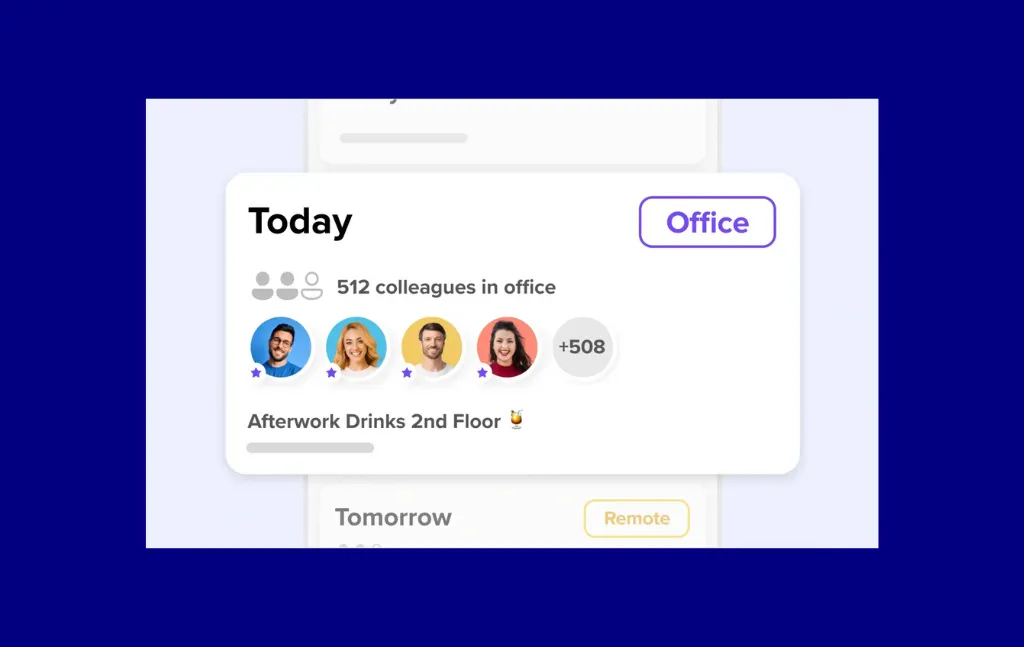
deskbird is a hybrid workplace management platform with an employee-first, mobile-app-led approach.
Best for Robin users who: want a cheaper per-user model with stronger mobile UX, particularly EMEA-based teams that need multi-language support.
How it compares to Robin: deskbird keeps Robin’s per-user pricing model but at materially lower rates ($3.75 per active user per month vs Robin’s market-estimated $5 to $8), and ships a stronger mobile app and employee personalization layer. Active-user pricing means you only pay for users who book.
Where it wins vs Robin: Lower per-user rate, mobile-first design, employee personal feed with colleague tracking, multi-language UI for EMEA teams, HRIS integrations with BambooHR and Personio.
Where it falls short of Robin: Recurring bookings for hybrid schedules are reportedly difficult to set up. SCIM and SAML are paywalled behind a User & Data Management Plus add-on ($0.50/user/month). General support response time is 1 to 2 days outside Enterprise. No way to close the office to bookings on specific days.
Core features:
Integrations: Microsoft 365, Microsoft Teams, Google Workspace, Slack, BambooHR, Personio, Okta (via SCIM/SAML add-on).
Pricing: Business $3.75/active user/month (annual). Professional and Enterprise custom. Visitor Plus add-on $150/location/month. SCIM/SAML add-on $0.50/user/month. Onboarding $800 to $22,500 one-time.
G2 rating: 4.5/5 (279 reviews). Capterra: 4.7/5 (93 reviews).
Bottom line for Robin switchers: Good fit for hybrid teams under 500 employees who want a cheaper per-user model without losing modern UX. Not the right fit for North American teams that need same-time-zone enterprise support, or for any organization with SSO requirements where SCIM/SAML pricing matters.
%20platform.webp)
Eptura Engage is the desk and room booking product inside Eptura’s enterprise workplace platform, formed from the merger of iOffice, SpaceIQ, and Condeco.
Best for Robin users who: have outgrown Robin’s enterprise scale (5,000-plus employees, multi-venue across countries) and need a true IWMS-adjacent platform.
How it compares to Robin: Engage targets larger enterprise scale than Robin, with multi-venue insights and hardware integrations that Robin doesn’t match. The trade-off is that Engage feels heavier in setup and daily use, and lacks native Google Workspace and Slack integrations.
Where it wins vs Robin: Multi-venue analytics across country, region, office, and team. Hardware room booking screens with badge integration. Working status mandates (admins can enforce remote vs in-office days). Wayfinder displays.
Where it falls short of Robin: UX is reported as clunky on G2 (Eptura Engage Capterra rating is 3.9/5, lower than every other tool in this guide). No native Google Workspace integration. No Slack app. Per-user pricing is opaque and tends to run higher than Robin. Bookings are difficult to amend.
Core features:
Integrations: Microsoft 365, Microsoft Teams, Outlook, Okta, Azure AD. No native Google Workspace, no Slack.
Pricing: Quote-only as of April 2026. Plans: Advanced, Power. Per-user, custom enterprise pricing. Generally runs higher than per-user competitors at comparable feature tiers.
G2 rating: 4.1/5 (~175 reviews). Capterra: 3.9/5 (72 reviews, listed under Condeco Desk Booking).
Bottom line for Robin switchers: Best fit for 5,000-plus-employee enterprises with multi-country operations and a dedicated workplace technology team. Not the right fit for anyone smaller, anyone on Google Workspace, or any team that prioritizes employee adoption (low adoption is the most-cited Engage failure mode).
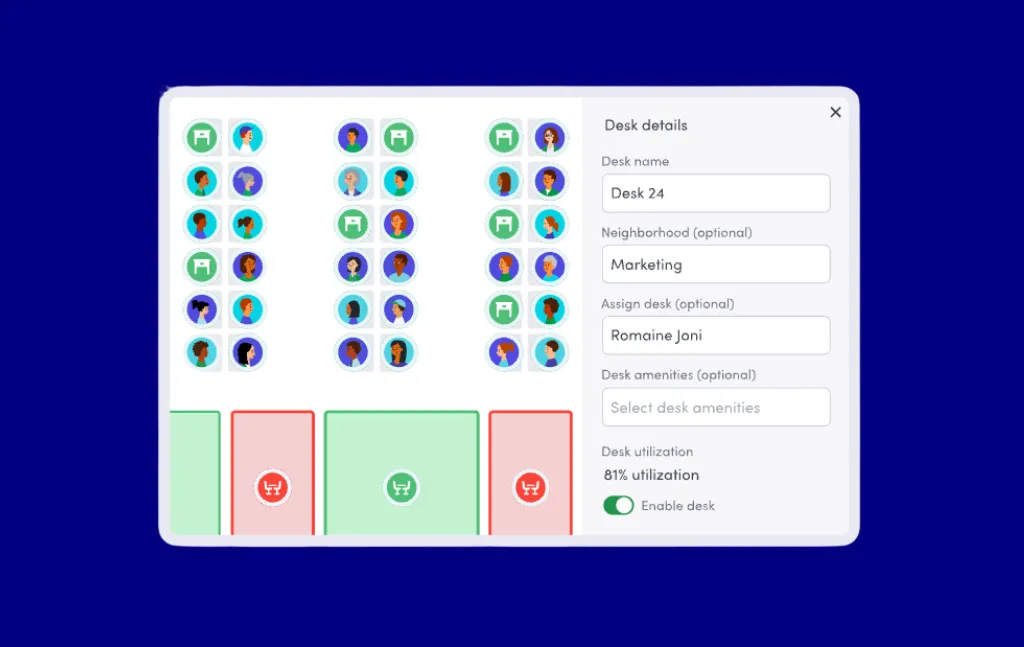
Envoy is the gold standard for visitor management, with workplace booking layered on top.
Best for Robin users who: primarily need visitor management for regulated industries (defense, pharma, healthcare, data centers) and want desk booking as a secondary capability.
How it compares to Robin: Envoy switched from per-user to per-resource pricing in 2025, which makes it more predictable than Robin at scale, but it bills you in pieces (platform fee, plus Reservations, plus Visitors, plus Deliveries, plus Screens). Workplace booking is positioned as a layer of the visitor-management platform, not the headline product.
Where it wins vs Robin: Best-in-class visitor management with badge printing, photo capture, virtual front desk, and legal document signing. Per-resource pricing for desks. Emergency Alerts product for regulated industries. Geolocation auto check-in.
Where it falls short of Robin: Rules engine works at the location level only (no quotas, conditions, buffers, approvals). Auto check-in for rooms doesn’t apply. WiFi auto check-in requires enterprise SSO integration. SCIM and custom admin roles are gated behind the Enterprise platform plan.
Core features:
Integrations: Microsoft 365, Google Workspace, Slack, Okta, Azure AD, Salesforce.
Pricing: Premium or Enterprise platform plan plus add-ons. Reservations ~$5/resource/month. Visitors: Basic free, Premium ~$362/location/month. Deliveries ~$250/location/month. Screens ~$12/device/month. Emergency Notifications $2/user/month.
G2 rating: 4.4/5 (164 reviews on Envoy Workplace). Capterra: 4.8/5 (428 reviews).
Bottom line for Robin switchers: Best fit for regulated industries where visitor security and compliance are the primary driver and desk booking is a secondary need. Not the right fit if booking is your only use case (the platform fee plus add-on math gets hard to justify), or if you need a deep rules engine for governance.
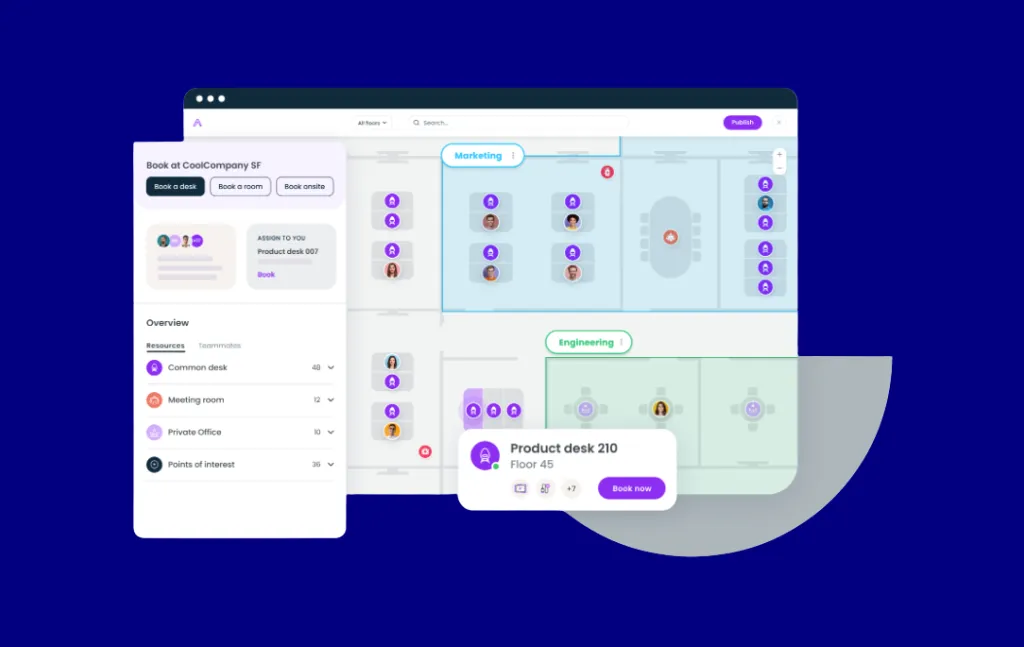
Gable is a per-user workplace platform that bundles internal office bookings with access to on-demand coworking spaces across 17,000-plus locations.
Best for Robin users who: have distributed teams that need occasional access to coworking spaces alongside the home-office booking system.
How it compares to Robin: Gable matches Robin’s per-user pricing model but at a lower entry price ($2.50/user/month for Standard vs Robin’s market-estimated $5 to $8), and adds a coworking marketplace component that Robin doesn’t offer.
Where it wins vs Robin: Lower per-user rate. On-demand coworking marketplace built into the same platform (17,000-plus spaces, 900-plus cities). Clean desk-booking UX.
Where it falls short of Robin: Limited rules and governance depth. Smaller feature surface than Robin overall. Some workplaces have a 4 PM local cutoff for next-day reservations, which has shown up in user feedback. No significant Capterra review presence makes peer signal harder to verify.
Core features:
Integrations: Slack, Microsoft Teams, Google Workspace, Microsoft 365.
Pricing: Standard $2.50/user/month. Enterprise custom. Visitor management: Basic $99/location/month, Standard $249/location/month, Enterprise custom. On-demand coworking is enterprise-only.
G2 rating: 107 reviews on G2 (rating not consistently published). No significant Capterra presence as of May 2026.
Bottom line for Robin switchers: Best fit for distributed-workforce companies that need an integrated coworking benefit alongside the internal booking platform. Not the right fit if you need deep booking governance or if external peer-review signal is part of your procurement diligence.
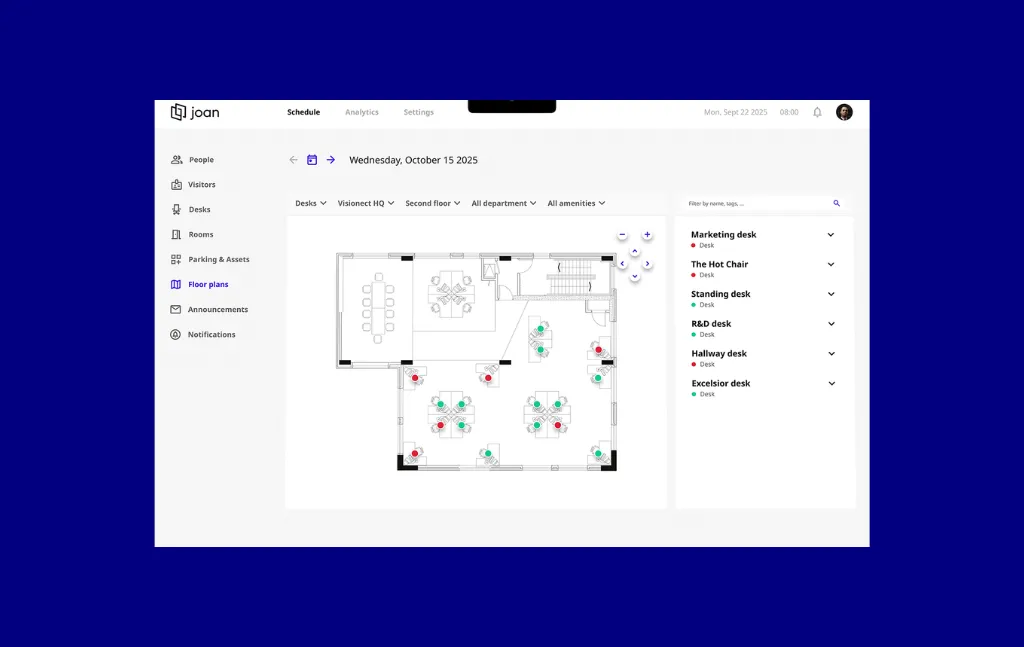
Joan is a hardware-led meeting room and desk booking platform with bundled all-inclusive pricing.
Best for Robin users who: prioritize ePaper room display tablets, want all features included at every tier, and run meeting-room-heavy offices in EMEA.
How it compares to Robin: Joan replaces Robin’s per-user pricing with a base subscription that includes a set number of users and devices, with all features unlocked at every tier (no feature gating). Joan’s strength is meeting rooms; desk booking is a 2020 addition.
Where it wins vs Robin: All-inclusive feature pricing (no add-on tax). Native ePaper hardware for room displays with low power consumption. Geolocation auto check-in within 200m radius.
Where it falls short of Robin: Floor plan UI is reportedly clunky (uploaded images, hard to edit). Basic rules engine (no buffer times, quotas, tag-based windows, or approvals). No custom space types or custom fields. No public booking links. Software-only deployments lack depth (Joan’s strength is hardware-bundled).
Core features:
Integrations: Microsoft 365, Google Workspace, Microsoft Teams, Outlook, Okta.
Pricing: Base $51/month with included users and devices. Added users $1.09/user/month, added devices $10.99/device/month. Plans by user/device threshold (Team, Organization, Business, Enterprise). All features included at every tier.
G2 rating: 4.7/5 (~253 reviews). Capterra: 4.8/5 (77 reviews).
Bottom line for Robin switchers: Best fit for offices with heavy meeting room usage who want hardware-bundled scheduling and predictable all-inclusive pricing. Not the right fit for hot-desking-heavy or non-traditional space environments (labs, equipment, parking).
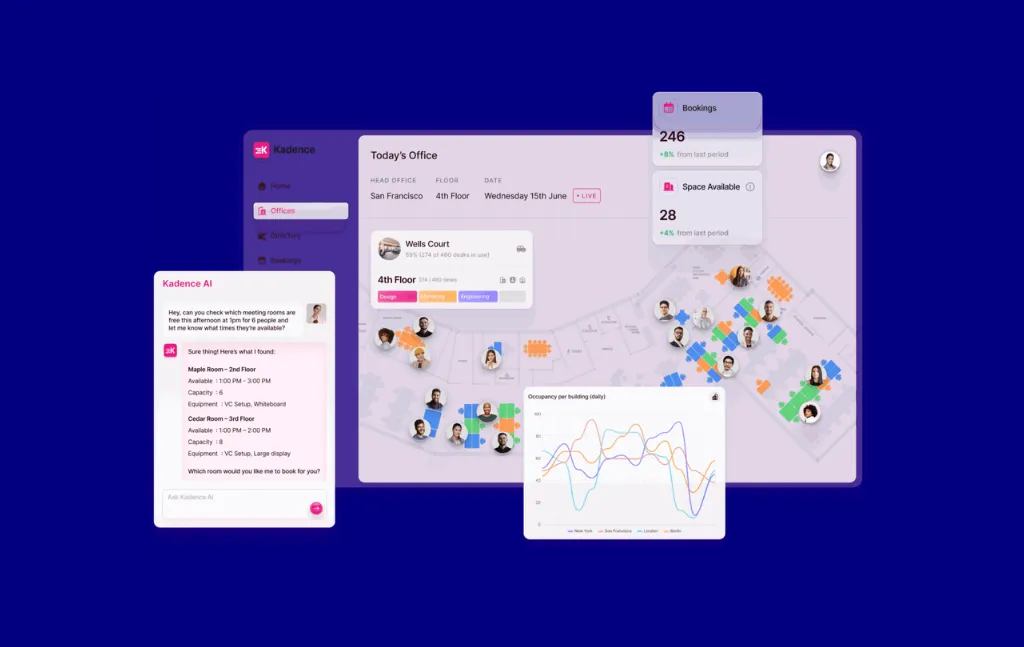
Kadence is a hybrid workplace platform with AI chat-to-book features, HR-led positioning, and Slack/Teams integration.
Best for Robin users who: want Robin’s AI feel (chat-to-book, predictive features) at a lower price point with stronger Slack/Teams adoption.
How it compares to Robin: Kadence is the closest functional parallel to Robin in this guide. AI natural-language chat-to-book, multi-venue navigation, and assigned space sharing all match Robin’s positioning. Kadence keeps per-user pricing but historically runs lower than Robin, with a free trial that Robin doesn’t offer.
Where it wins vs Robin: AI chat-to-book integrated with Slack and Teams. Public API for custom check-in workflows. Multi-venue floor plan navigation. Free trial available.
Where it falls short of Robin: Preset space types only (no custom space definitions). Cannot create user tags (only teams, which are less functional for access control). Cannot restrict room access by user. $250 per floor plan upload as an ongoing cost. Insights Plus (custom reporting) is a paid add-on. White-glove onboarding only for Enterprise.
Core features:
Integrations: Microsoft Teams, Slack, Microsoft 365, Google Workspace, Okta.
Pricing: Quote-only as of April 2026. Plans: Kadence Standard, Kadence Enterprise. Previously ~$4/user/month, current pricing requires sales engagement. Insights Plus custom reporting at extra cost. $250/floor plan upload.
G2 rating: 4.5/5 (~136 reviews). Capterra: 4.6/5 (29 reviews).
Bottom line for Robin switchers: Best fit for HR-led hybrid teams who want Robin’s AI scheduling feel without the enterprise price tag. Not the right fit for facilities-led organizations that need org-wide rules governance, custom space types, or free floor plan changes.
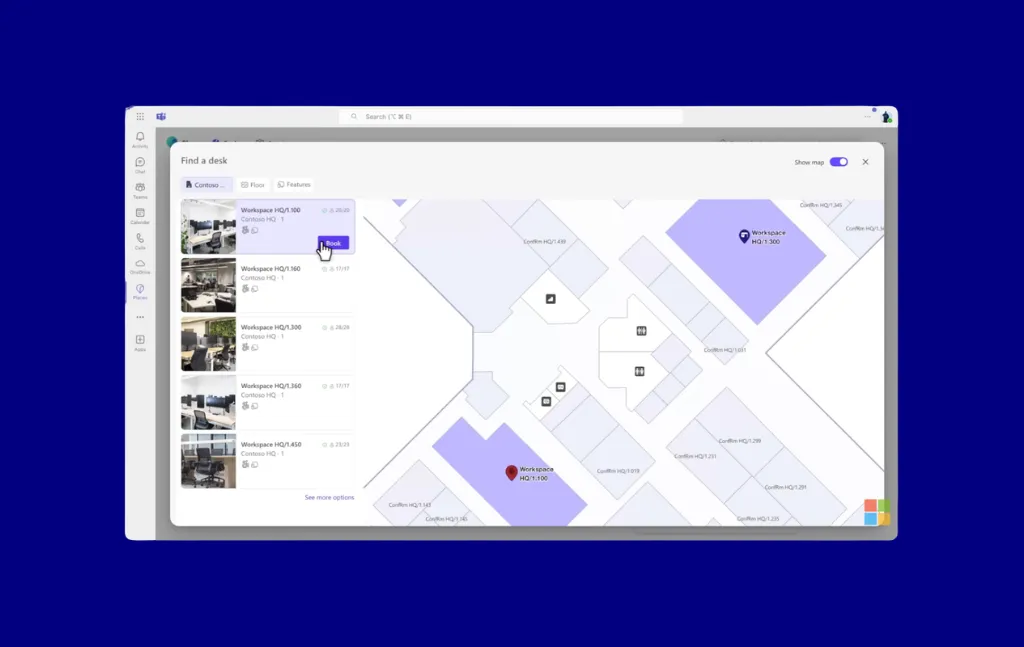
Microsoft Places is Microsoft’s hybrid work coordination tool, built into the M365 stack and reaching general availability in mid-2025.
Best for Robin users who: are already deep in M365, primarily need meeting room booking (rooms are essentially free), and have the IT capacity to manage IMDF floor plans via PowerShell.
How it compares to Robin: Places trades Robin’s standalone platform for native M365 integration. Meeting room booking via Outlook and Teams is bundled into existing licenses. The catch is that individual desk booking, auto-release, and occupancy reports require the per-space Shared Space license at $8/license/month.
Where it wins vs Robin: Native Outlook, Teams, and M365 integration. Rooms are bundled (no separate room license). Copilot AI integration. Workplace presence visible directly in Outlook and Teams.
Where it falls short of Robin: Floor plan setup requires IT (PowerShell, Microsoft Graph, IMDF standard), typically via a Microsoft partner. Thin rules engine (no buffer rules, conditions, quotas, tag-based permissions, approvals). Desk pooling only out of the box (specific desk booking requires Shared Space license). Narrow space coverage (rooms, workspaces, individual desks only; no parking, labs, lockers).
Core features:
Integrations: Native to M365 stack. No native non-Microsoft integrations.
Pricing: Core functionality included in all M365 licenses with Outlook/Teams calendar access. Teams plans $4 to $8.55/user/month. M365 plans $6 to $57/user/month. Shared Space license $8/license/month (4 desks or 1 Teams panel). Copilot add-on $30/user/month enterprise. Note: July 2026 M365 commercial price increase is expected.
G2 rating: Limited public review presence. Most feedback flows through Microsoft community forums and enterprise IT channels.
Bottom line for Robin switchers: Best fit for M365-heavy organizations whose primary need is meeting room booking, who have IT capacity for partner-led floor plan setup, and who can accept thin rules governance. Not the right fit for desk-booking-heavy environments, any team needing custom space types, or any organization where IT can’t take on PowerShell/IMDF maintenance.
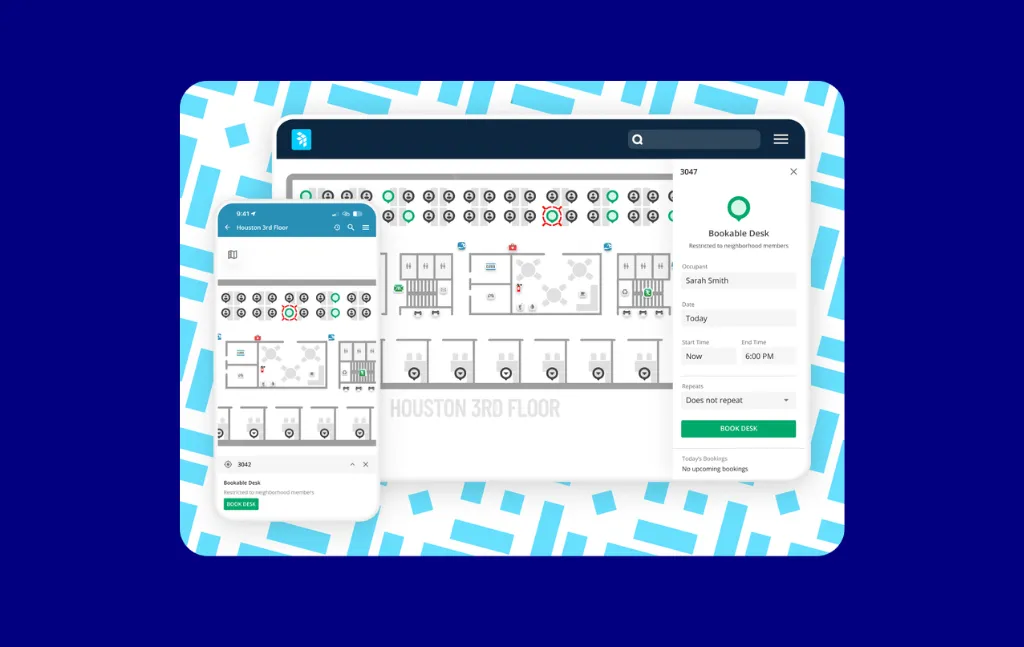
OfficeSpace is a full-suite workplace management platform with space planning, asset management, and visitor management bundled in.
Best for Robin users who: outgrew Robin’s booking focus and now need facilities-grade space planning, move management, or asset tracking inside the same platform.
How it compares to Robin: OfficeSpace keeps Robin’s per-user pricing model but adds space planning, asset management, and facility request features that Robin doesn’t include. It targets the facilities team more directly than Robin (which targets IT and workplace experience).
Where it wins vs Robin: AI assistant (Ossie) for booking and insights. Desk lending (employees open up assigned desks when out). Space planning with scenario forecasting and move coordination. Asset management with depreciation tracking. Multi-venue world map view.
Where it falls short of Robin: Pricing is opaque (contact sales). Google Calendar sync blocks the entire day when a desk is booked (frequent G2 complaint). Even entry-tier (Essentials Plus) includes space management features that are overkill for booking-only use cases. Utilization reporting has historically been gated behind higher tiers.
Core features:
Integrations: Microsoft 365, Microsoft Teams, Google Workspace (with known sync issues), Outlook, Okta.
Pricing: Quote-only as of April 2026. Plans: Essentials Plus, Pro Plus. Per-user with fixed platform fee plus implementation fee. Room booking historically gated by tier. Utilization metrics historically Pro Plus only.
G2 rating: 4.7/5 (141 reviews). Capterra: 4.9/5 (55 reviews).
Bottom line for Robin switchers: Best fit for facilities-led organizations that need IWMS-adjacent capabilities (space planning, asset tracking, move management) inside the booking platform. Not the right fit for booking-only use cases (you’ll pay for complexity you don’t need), or for Google Workspace shops (the calendar sync issue is real).
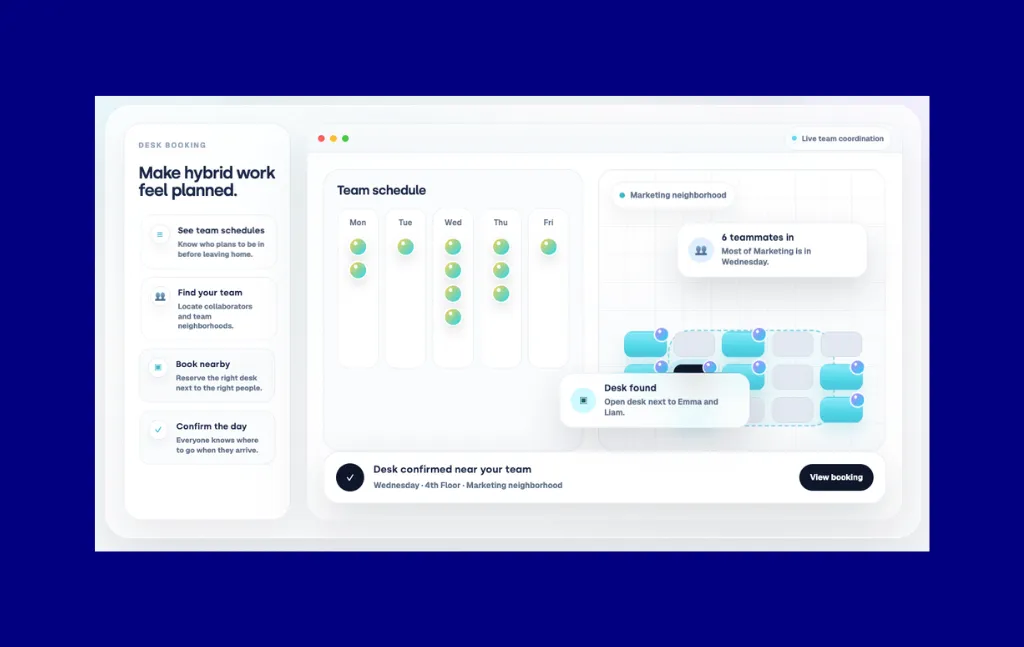
Tactic is a per-workspace booking platform with the lowest published entry pricing in this guide.
Best for Robin users who: want a per-resource pricing model (similar to Skedda) at the lowest published rate, with a fast deployment timeline.
How it compares to Robin: Tactic replaces Robin’s per-user pricing with per-workspace pricing at $3 to $4 per workspace per month, including all major booking features. Implementation is reportedly fast (most teams live within 48 to 72 hours), which contrasts directly with the implementation friction G2 reviewers cite for Robin.
Where it wins vs Robin: Lowest published per-resource rate in this guide. Fast time-to-live. Per-workspace pricing math is similar to Skedda’s per-space model. Customer base includes Microsoft, United Nations, Grammarly, and Northwestern University.
Where it falls short of Robin: Smaller feature surface than Robin overall. Advanced booking rules and Tessa AI require the Pro tier. Free trial details not consistently published. Less peer-review depth than Robin (fewer total reviews across sites).
Core features:
Integrations: Microsoft 365, Microsoft Teams, Google Workspace, Slack, Okta.
Pricing: Core $3/workspace/month. Pro $4/workspace/month (adds visitor management, Tessa AI, advanced rules, SSO). Enterprise custom. Annual and multi-year contract pricing available.
G2 rating: “Highest satisfaction score” in Desk Booking, Meeting Room Booking, Space Management, and Hybrid Enablement categories on G2 (rating breakdown not consistently retrievable). Capterra: 4.7/5 (73 reviews).
Bottom line for Robin switchers: Best fit for cost-driven users who want the lowest published per-resource rate, fast deployment, and a Skedda-like pricing model. Not the right fit for organizations that need deep enterprise governance, full IWMS scope, or the largest peer-review dataset for procurement diligence.
This is the question every person asks. Honest answer: it’s a 2 to 6 week migration depending on size, with three specific pitfalls to plan around.
Robin allows data export of booking history, user data, and space data via CSV. The API is available on higher tiers for direct sync. Floor plan files, if Robin’s professional services team built them, may not export in editable format; you may need to recreate them in your new tool, which is one reason Skedda offers free floor plan recreation as part of the migration.
Skedda’s standard onboarding includes floor plan recreation in 2 business days, rules engine configuration, SSO and SCIM setup, and a dedicated implementation contact during the migration window. No separate migration package or upcharge. Premier tier customers get a named customer success contact.
Book a demo to talk through your specific Robin migration scope.
Why are people switching from Robin?
The most-cited reason is per-headcount pricing that doesn’t match in-office utilization. Robin charges based on total employee count, not active users, which leaves hybrid offices paying daily rates for monthly visitors. Add-on costs for visitor management, advanced analytics, premium support, and floor plan changes compound the sticker price.
Is Robin still worth using?
Yes, for some teams. Robin’s AI Scheduling Agent, predictive booking, and workplace dashboard are real differentiators for enterprise organizations (2,000-plus employees) with dedicated workplace operations teams. If AI scheduling is a top-three priority and budget isn’t the constraint, Robin remains a credible choice in 2026.
What’s the cheapest Robin alternative?
Tactic at $3 per workspace per month is the lowest published entry rate in this guide. Gable at $2.50 per user per month is cheaper on a per-user basis but operates on a different pricing model.
Can I export my data from Robin?
Yes. Robin supports CSV export of booking history, user data, and space data. API export is available on higher tiers for direct integration. Floor plan files built by Robin’s professional services team may not export in editable format; plan to recreate them in your new tool.
How long does it take to migrate from Robin?
Most mid-market migrations (100 to 1,000 users) take 2 to 6 weeks. Tactic and Skedda can complete a basic migration in under 4 weeks. Microsoft Places and Eptura Engage typically run 6 to 16 weeks because of partner involvement and enterprise scope. Plan a 1-week SSO testing window with IT regardless of tool.
Are there free alternatives to Robin?
There are no fully free workplace booking platforms in this guide that match Robin’s feature scope. Microsoft Places offers free meeting room booking for M365 customers (rooms are bundled as Exchange resources), but desk booking with auto-release and occupancy reports requires the $8/license/month Shared Space SKU. Most platforms offer a free trial of 14 days or longer.
What’s the best Robin alternative for cost-driven switchers?
For organizations with hybrid attendance under 70% and headcount over 100, per-space or per-resource pricing wins on 12-month TCO. The strongest fits are Skedda (per-space, unlimited users), Tactic (per-workspace, lowest published rate), and Archie (per-space for SMB). Skedda’s $15,000 estimated TCO at 100 users compares to Robin’s $35,000 at the same scale (per ITQlick’s 2026 analysis).
The biggest concern most people switching from Robin raise isn’t the per-user math; it’s the fear that migration will break the booking workflow employees rely on. The reality is that a well-scoped migration runs in the background while Robin keeps operating, and the new tool goes live with floor plans, rules, and integrations already configured.
If you’ve already decided per-space pricing is the right direction, book a demo and we’ll walk through what the migration looks like for your specific headcount, space count, and integration stack. No commitment beyond the demo. If Skedda isn’t the right fit at the end of the conversation, the other 10 options in this guide are still here.
Our team is ready and waiting to talk through your specific desk scheduling requirements and see how Skedda could work for you.

.svg)