
Keeping Your Data Close to Home
When you book a desk or meeting room, your name, booking, and account details are saved on a server. That server sits in a building, and that building is in a particular country. Data residency is the term for that location. It answers a simple question: which country or region is your data stored and processed in?
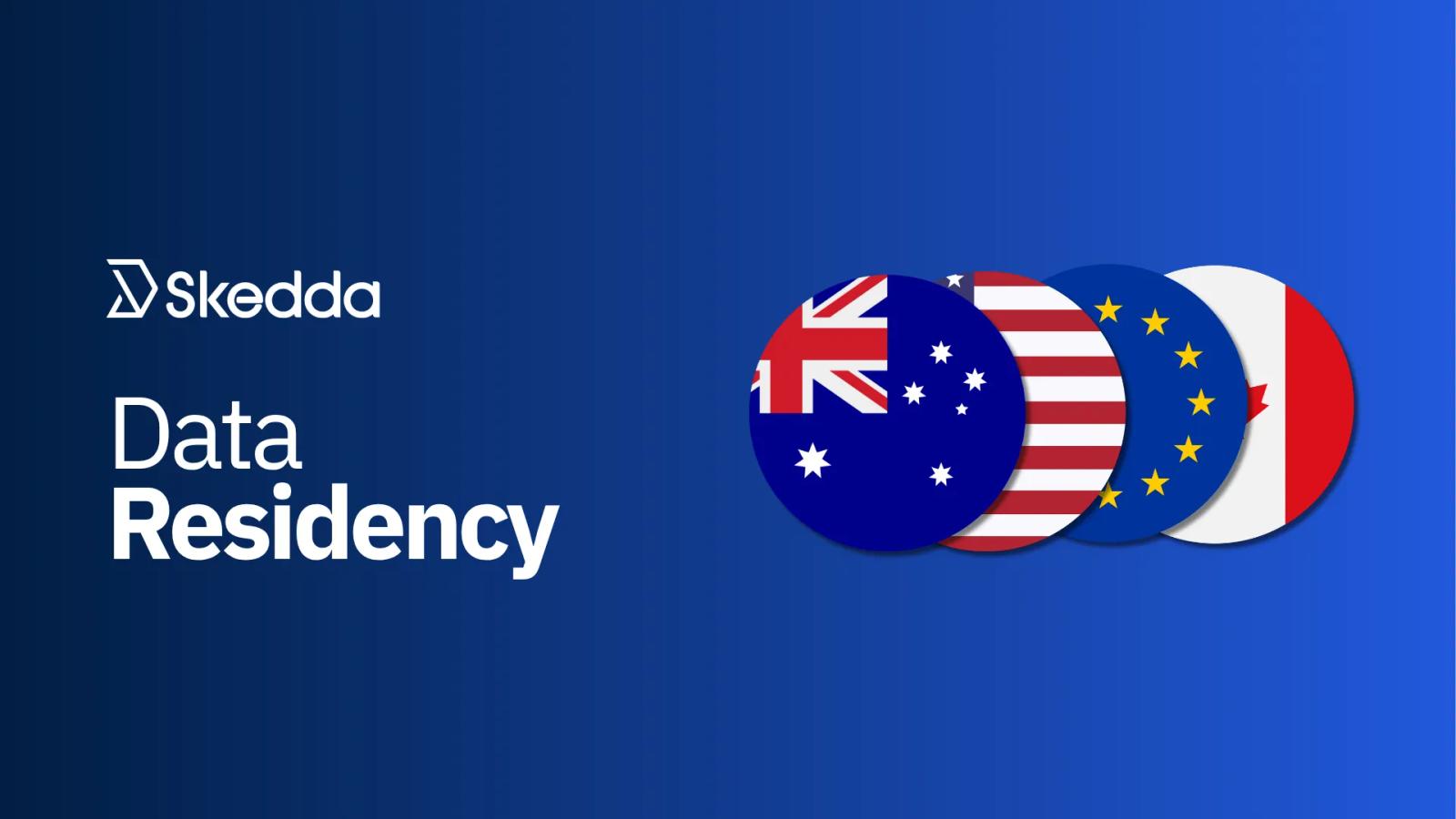
For us, that answer began in Australia. We got our start in Melbourne back in 2013, and although our headquarters have since moved to the US, we still consider Australia home. That's why it was the first region outside the US where we decided to support data residency. Canada and the EU now sit alongside it, built the same way.
How Skedda’s Regional Hosting Works
Each Skedda account runs on Microsoft Azure servers in the region you choose, with its own database, application servers, and login system. No region shares a database or a login system with another, so a booking made in Munich is handled by servers in the EU.
Our approach is to give every region its own deployment. Because the infrastructure is separate, keeping your data in-region doesn't depend on a setting or a rule in the application code.
Here's what that separation looks like in practice:
- Separate Azure resources. Every region has its own database, application servers, and authentication system.
- Region-specific addresses. Each region has its own web addresses and security certificates, such as venue addresses ending in eu.skedda.com.
- Separate logins. Sessions and encryption keys are specific to each region, so a login in one region doesn't carry into another.
Where Your Data Lives Shapes Software Decisions
Organizations have always judged software on features and price. But there is a quieter question that comes up just as often: where is our data stored once we go live? Government bodies, healthcare providers, and financial institutions typically write the answer into their requirements.
Regional hosting is how we're growing into a booking platform that fits the way you work, wherever your office is located, and whatever your regional mandates are.
Shorter security conversations, faster procurement
Many software deals don't just stall on features or price. They stall in security review, often on the question of data residency. With Skedda, when IT or legal asks where the data lives, the answer is simple: your data doesn’t cross borders. This means fewer follow-ups, a quicker data processing agreement review, and a faster path from decision to go-live.
Wider coverage means more confidence
Regional hosting is a big undertaking, and we committed to it fully. Every region is a separate deployment to build, secure, and run, which is why many space management platforms stop at one or two regions. With coverage across the US, Canada, the EU (Germany), and Australia, Skedda is one of the best systems equipped to handle data hosting requirements.
Fewer cross-border rules to explain
Privacy law follows the data. In Australia, an organization that sends personal information overseas stays accountable for how the recipient handles it (OAIC). In the EU, personal data leaving the European Economic Area needs a legal transfer tool, such as standard contractual clauses (EDPB). When an account's primary data lives in the customer's own region, there's less cross-border handling to document and defend.
And We’re Just Getting Started
We’re continuing to improve how we handle different technical requirements behind regional data hosting. While new accounts going through onboarding have the option to choose their hosting region, migration for existing accounts is not currently supported at this time. We're also working to bring more of the integrations our customers use into the new regions, starting with tools like Slack, Zoom, WebEx, and Zapier, rolling out over time.
If data residency is on your evaluation checklist, book a demo to see Skedda in action and learn about how regional hosting works.